
Learn About AEDs
Find answers to common AED questions and discover the life-saving potential of Automated External Defibrillators.
Cardiac Arrest
Cardiac Arrest is when the heart stops. When someone stops breathing, stops responding, or you’re unable to feel a pulse, an AED needs to be applied.
The steps to follow are:
Step 1:
Call 911
Step 2:
Start CPR
Apply the AED
Cardiac arrest is the most common cause of death in the United States. In most cases, an individual will have no symptoms prior to an episode. Cardiac arrest is often the first sign of an underlying condition, as there are many factors aside from heart attacks that can cause cardiac arrest.
The most important thing to remember is that in order to treat cardiac arrest, we must first treat the abnormal heart rhythm that causes it or results from it. CPR alone cannot accomplish this.

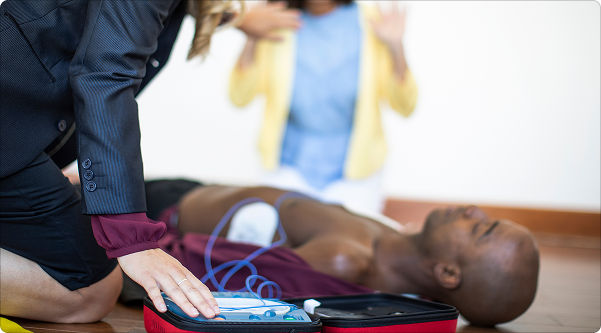
While CPR is extremely important to keep the blood flowing to the vital organs (and especially the brain) during the time that the heart is not working, the most effective way to save a life in cardiac arrest is to get the heart pumping again on its own.
Even after a major heart attack, the heart usually still has plenty of function to pump the blood- however, the heart is in an abnormal rhythm that cannot function. The heart MUST be shocked in order to reset back to a normal rhythm and restore blood flow to the brain. After a cardiac arrest, there is only an 8% chance of surviving without doing anything other than CPR.
Every Minute Counts:
How AEDs Save Lives in Critical Moments
General Questions
- Devices
What is an AED?
What all is included with the purchase of an AED?
Can AEDs be used on children?
How do I know if my AED is working?
Where should I keep my AED?
Do I need to plug-in my device to charge?
What happens if I do something incorrectly when using the AED?
- Accessories
Will you install the cabinets and wall mounts?
When do I need to replace pads and batteries?
- Pads (Adult & Child) – every 2 years*
- Batteries – every 4 Years
- Child keys (used with the FRx device) do not expire.
- *Pads must be replaced after each use.
- Firehouse AED will send reminders for purchase when our records indicate your pads and batteries are coming up for replacement.
Which AED Case is right for me?
- Standard Carry Case includes room for an extra set of pads or child pads.
- Waterproof Shell Carry Case – For AEDs that will be used in outdoor, rugged conditions.
- Slim Carry Case – Compact case for ease of storage
- Other
